

Why Fractional Marketing Leaders See Things Full-Time Leaders Miss
Fractional marketing leaders often identify growth challenges more quickly because they operate across multiple organizations simultaneously. While full-time marketing leaders develop deep organizational knowledge, fractional leaders develop broad pattern recognition. Exposure to different leadership teams, commercial strategies, market conditions, and organizational challenges allows them to recognize recurring patterns, challenge assumptions, and identify root causes before organizations invest time and resources in solving the wrong problem.
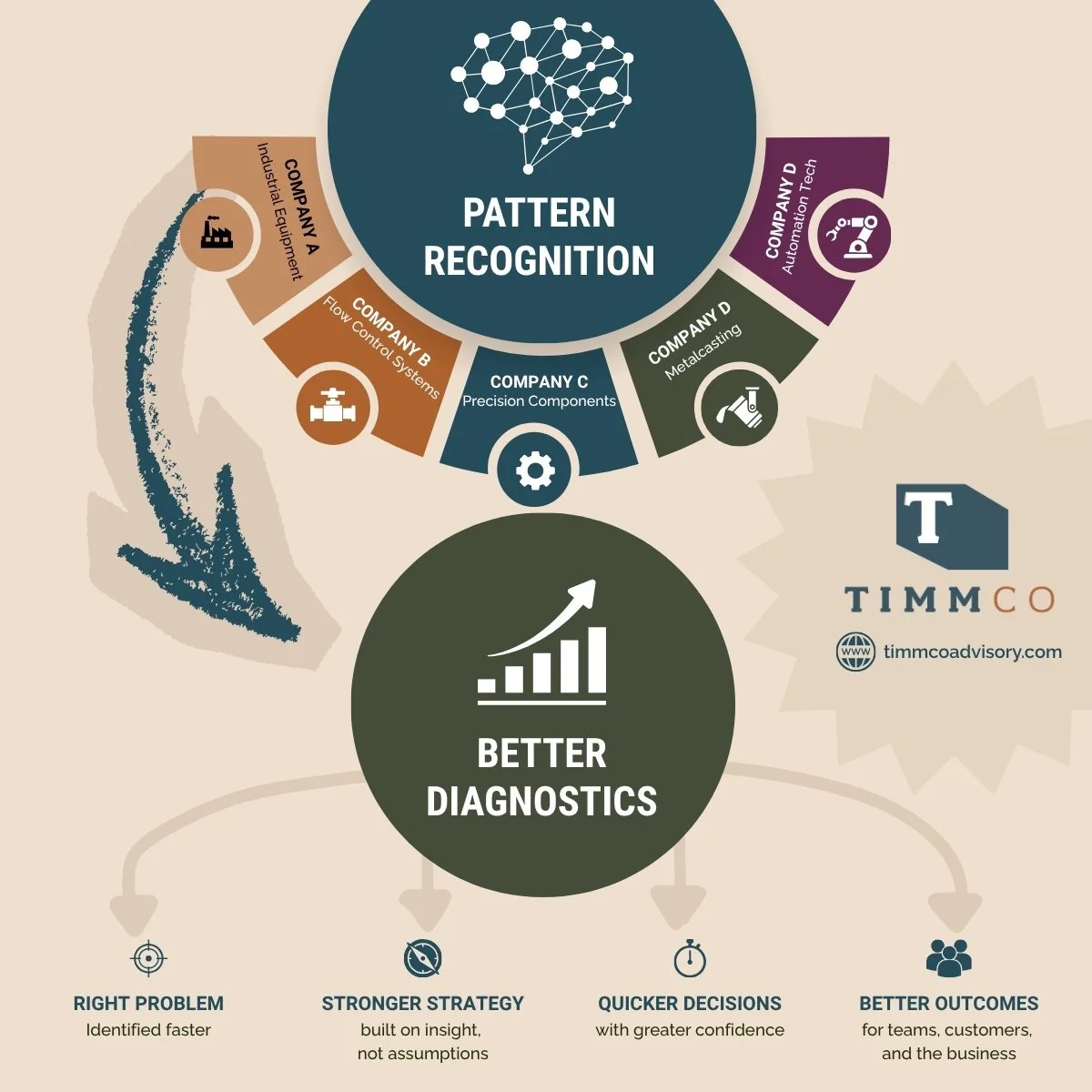
Pattern recognition is the hidden advantage of fractional marketing leadership. By working across multiple manufacturing and industrial B2B organizations, fractional executives recognize commercial patterns faster, leading to better diagnosis, stronger strategy, faster decisions, and improved business outcomes.
Key Takeaways
Full-time leaders develop deep organizational knowledge; fractional leaders develop broad pattern recognition.
Many commercial challenges repeat across industries, products, and markets.
Faster diagnosis often leads to faster and more effective decisions.
Not every marketing problem is a marketing problem.
The value of fractional leadership often lies in accelerated learning, not additional capacity.
The Commercial Problem
Over the past several months, I've spoken with Presidents, Chief Commercial Officers (CCO), Chief Revenue Officers (CRO), and Vice Presidents of Sales & Marketing across manufacturing and industrial B2B organizations.
The questions sound remarkably similar.
Why aren't leads converting?
Why are RFQs increasing, but revenue remains flat?
Why do customers say we're different but struggle to explain why?
Which marketing efforts are creating pipeline, and which are just creating work? Why is marketing busy while growth feels uncertain? The answers are rarely as obvious as they appear.
Having sat on the commercial side of the table, I know commercial leaders often have to make decisions before the full picture emerges. When revenue targets, customer demands, operational priorities, and market shifts are all happening at once, distinguishing symptoms from root causes isn't always straightforward.
The Symptom
Many manufacturing organizations are doing plenty of marketing: Campaigns are running, trade shows are scheduled, content is being published, and the website is generating traffic. The challenge isn't always a lack of activity. It's understanding which activities are actually influencing growth.
Activity alone doesn't explain why customers choose one supplier over another, why the pipeline grows, or why growth stalls. It doesn't explain why one message resonates while another falls flat. And it doesn't explain whether current results are being driven by strategy, market conditions, or something else entirely. That's where organizations often mistake symptoms for a diagnosis.
If the pipeline slows, marketing needs account-based marketing or more campaigns.
If lead quality declines, marketing needs more quality leads.
If awareness is weak, marketing needs more content.
If consideration stalls, marketing needs a new demand strategy.
Sometimes those conclusions are correct. In my experience, these conclusions explain what is happening, but not necessarily why it's happening. When growth slows, it’s common to start examining the activity closest to the outcome. The underlying cause often sits several steps earlier in the process.
What Strategic Marketing Experience Reveals
Across manufacturers, foundries, engineered product companies, and industrial suppliers, I've noticed an interesting commonality:
The organizations are different.
The products are different.
The markets are different.
The patterns are often the same.
One company believes it has a lead generation problem. Another believes prospects don't recognize why it’s the best supplier. A third believes it has a sales process problem. After exposure across organizations, those challenges begin to look familiar.
The lead generation problem often turns out to be unclear positioning.
The differentiation problem often turns out to be expertise that isn't clearly communicated.
The sales problem often turns out to be qualification or process gaps.
The growth problem sometimes turns out to be market conditions.
The pattern matters because solving the wrong problem consumes time, money, and organizational attention.
The Root Cause Patterns I Commonly See
Pattern #1: The Lead Generation Problem That's Actually Positioning
A manufacturing company invests heavily in campaigns and lead generation.
The sales team wants more leads and better marketing-qualified leads (MQLs).
The issue isn't MQL volume.
By the time buyers engage sales, they've already spent considerable time researching potential solutions. The company hasn't clearly communicated which problems it solves, who it serves best, or why it belongs on the buyer's shortlist. (By the way, this isn’t my opinion; it’s backed by research. Read How B2B Buyers Research Before Contacting Sales — And What It Means for 2026.)
Pattern #2: The Marketing Problem That's Actually Sales Process
A commercial leader asks marketing to generate more leads.
Marketing generates more leads.
Revenue doesn't improve.
The issue isn't lead volume.
Sales and marketing are operating from different definitions of a qualified opportunity.
Pattern #3: The Visibility Problem That's Actually Expertise Discoverability
An engineering-heavy organization believes its experience should speak for itself.
Technical experts possess decades of industry knowledge.
The issue isn't lack of expertise or premium positioning.
The issue is that expertise isn't visible where buyers are researching, evaluating, and comparing suppliers.
Pattern #4:Growth That's Actually Market Conditions
A manufacturer experiences rapid growth.
The commercial team assumes the strategy is working.
A competitor exits the market.
A supply disruption creates business.
A reshoring initiative or natural disaster drives temporary demand.
The market is doing more of the work than the strategy.
Pattern #5: The Growth Problem That's Actually Consolidation
A manufacturer experiences rapid growth through acquisition.
Revenue increases.
Market share expands.
The commercial team assumes the commercial strategy is working.
The growth isn't necessarily coming from new customer preference.
It may be coming from customer consolidation, reduced competition, or inherited demand.
The acquisition created scale.
It didn't automatically create a stronger market position.
How Fractional Marketing Leaders Diagnose Faster
Research psychologist Gary Klein spent decades studying how experts make decisions under pressure.
His Recognition-Primed Decision (RPD) model emerged from research (2004) involving firefighters, military commanders, and other experienced professionals operating in uncertain environments. Klein found that experts often do not compare multiple options before acting. Instead, they recognize patterns from prior experience, identify a plausible course of action, mentally simulate the outcome, and move forward.
The critical insight is that expertise accelerates recognition.
Experienced decision-makers have seen similar situations before. They identify important signals faster. They distinguish symptoms from causes more quickly. They spend less time evaluating possibilities because experience has already narrowed the field.
That concept applies surprisingly well to commercial leadership.
Why Fractional Marketing Leaders See Clear Signals
A Vice President of Sales & Marketing may experience one CRM implementation, one repositioning effort, and one commercial transformation over several years.
A fractional leader may see five.
An executive may navigate one market disruption in his or her tenure with a company.
A fractional leader may observe several similar disruptions across different organizations during the same period.
The value isn't that the fractional leader works harder.
The value is exposure and compressed learning.
Fractional executive roles have more than tripled since 2018, according to workforce analytics firm Revelio Labs. Chief Marketing Officer (CMO) and Chief Financial Officer (CFO) roles represent the most common fractional executive positions. That growth reflects something beyond cost management. Organizations increasingly seek access to experience gained across multiple business environments.
Insight and Application for Manufacturing Leaders
For B2B and manufacturing leaders, the question isn't whether fractional leadership is better than full-time leadership.
Each serves the organization for different purposes and during different seasons.
Full-time leaders often possess deeper tribal knowledge. They understand culture, relationships, politics, history, and operational realities.
Fractional leaders often possess broader pattern recognition. They bring an outside perspective informed by multiple organizations, markets, and commercial challenges. Because they operate across companies and industries simultaneously, they often identify emerging patterns, recognize opportunities sooner, and see connections between market signals that may not be visible from inside a single organization.
The most effective use of fractional leadership often occurs when leadership teams need clarity before committing to significant investments or hiring agencies, staff and marketing technology.
Examples include:
A commercial transformation that isn't producing expected results.
A marketing function generating activity but not revenue impact.
A market positioning effort that lacks buyer engagement.
A website redesign, CRM implementation, or demand-generation investment where leadership wants confidence they're solving the right problem first.
The earlier organizations identify the upstream opportunity, the fewer human and financial resources they waste solving symptoms.
Questions to Consider
Before investing in another marketing campaign or activity, commercial leaders may want to ask:
Are we treating symptoms or addressing root causes?
What assumptions are driving our current market strategy?
Are current results caused by our actions or by market conditions?
What would a fresh perspective recognize immediately?
What go-to-market assumptions, patterns, or activities have we accepted simply because "that's how we've always done it"?
The Cost of Misdiagnosis
The advantage of a fractional leader isn't additional capacity, although that is certainly a benefit.
The edge is accelerated pattern recognition.
Full-time leaders develop deep organizational knowledge.
Fractional leaders develop broad pattern recognition and an outside perspective informed by multiple organizations, markets, and commercial challenges.
Both forms of expertise are valuable, but they're not synonymous.
Gary Klein's research suggests that experience allows leaders to recognize situations, identify likely causes, and act more quickly than isolated decision-makers. The distinguishing variable isn't intelligence; it’s exposure. The more situations someone encounters, the more recognizable the patterns become when the next challenge appears.
The most expensive growth problem is often the one an organization misdiagnoses.
The question isn't whether something needs to change. The question is whether you've identified the right problem first.
Author Perspective
Sara Timm helps manufacturing, industrial, and complex B2B organizations translate technical expertise into market visibility, sales alignment, and growth. Through Timmco Advisory, she helps leadership teams identify commercial patterns, clarify market signals, and diagnose growth challenges before investing in solutions.
